Managing Deployments
Deployments are a major part of military life. Whether it is the first or the fifth deployment, it is important to acknowledge that there are additional challenges and stressors placed on Defence families during deployments.
The R2MR for Family Life website aims to provide information, tools, and resources to support families with navigating the deployment journey.
It is common and expected for families to experience varying levels of stress throughout the deployment cycle. This is a normal reaction to stress during times of transition. For a closer look at how families adapt to these transitions, explore the Family Adaptation Curve below.
The analogy of a highway can help to explain the various phases of deployments. Click on the deployment highway below for a brief description of each of these phases: pre-deployment, deployment, rest stop, and post-deployment.
Pre-deployment phase
Pre-deployment phase
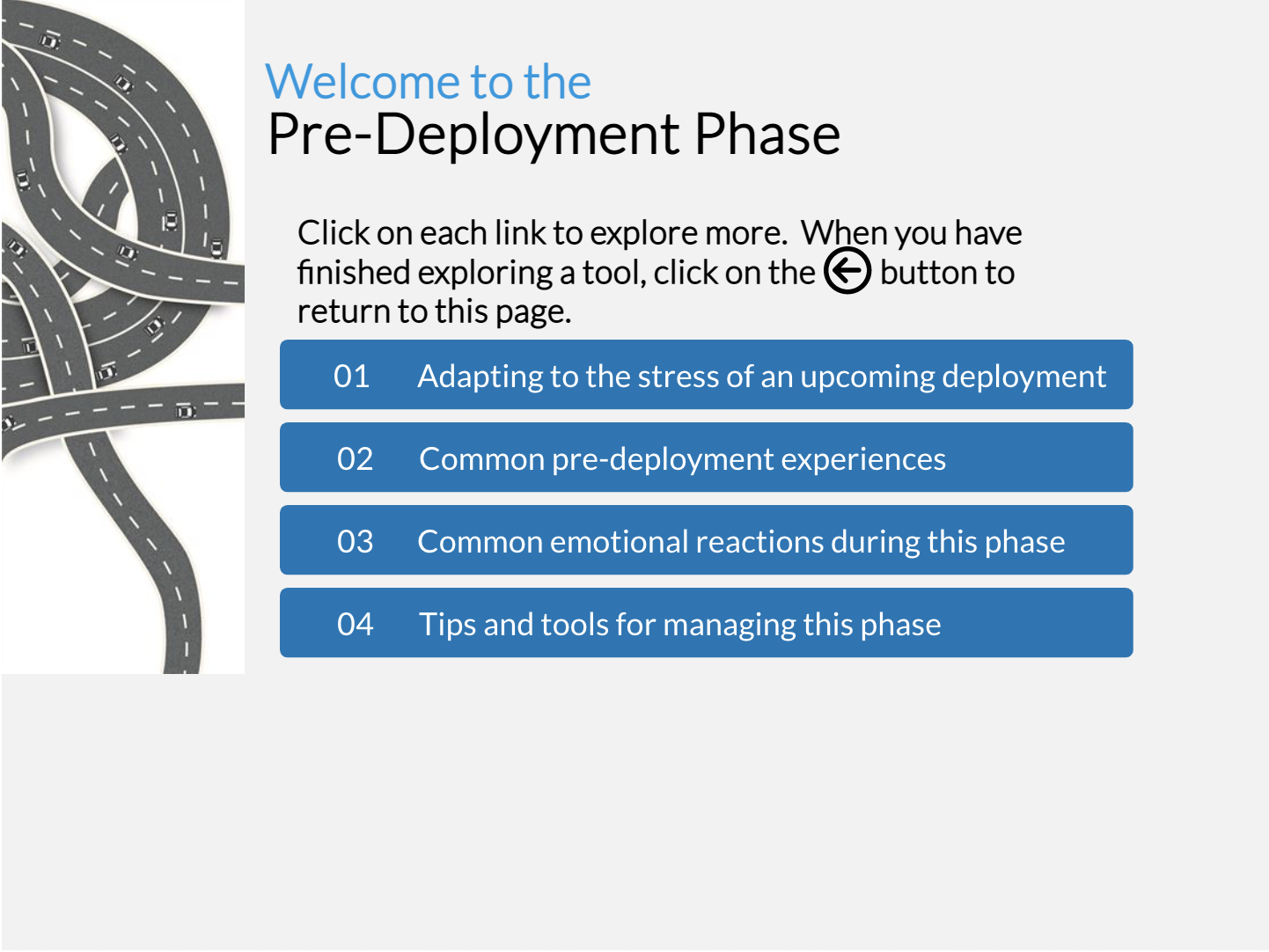
Estimated time: 10-15 min
Learning objectives
This activity will introduce you to common pre-deployment experiences and emotions, with numerous opportunities to take stock of and reflect on your own experiences.
Please note: the MFRC deployment app is no longer active
Pre-Deployment Checklists can help you keep track of the many personal administration items that you may need to organize and complete.
Deployment phase
Deployment Phase
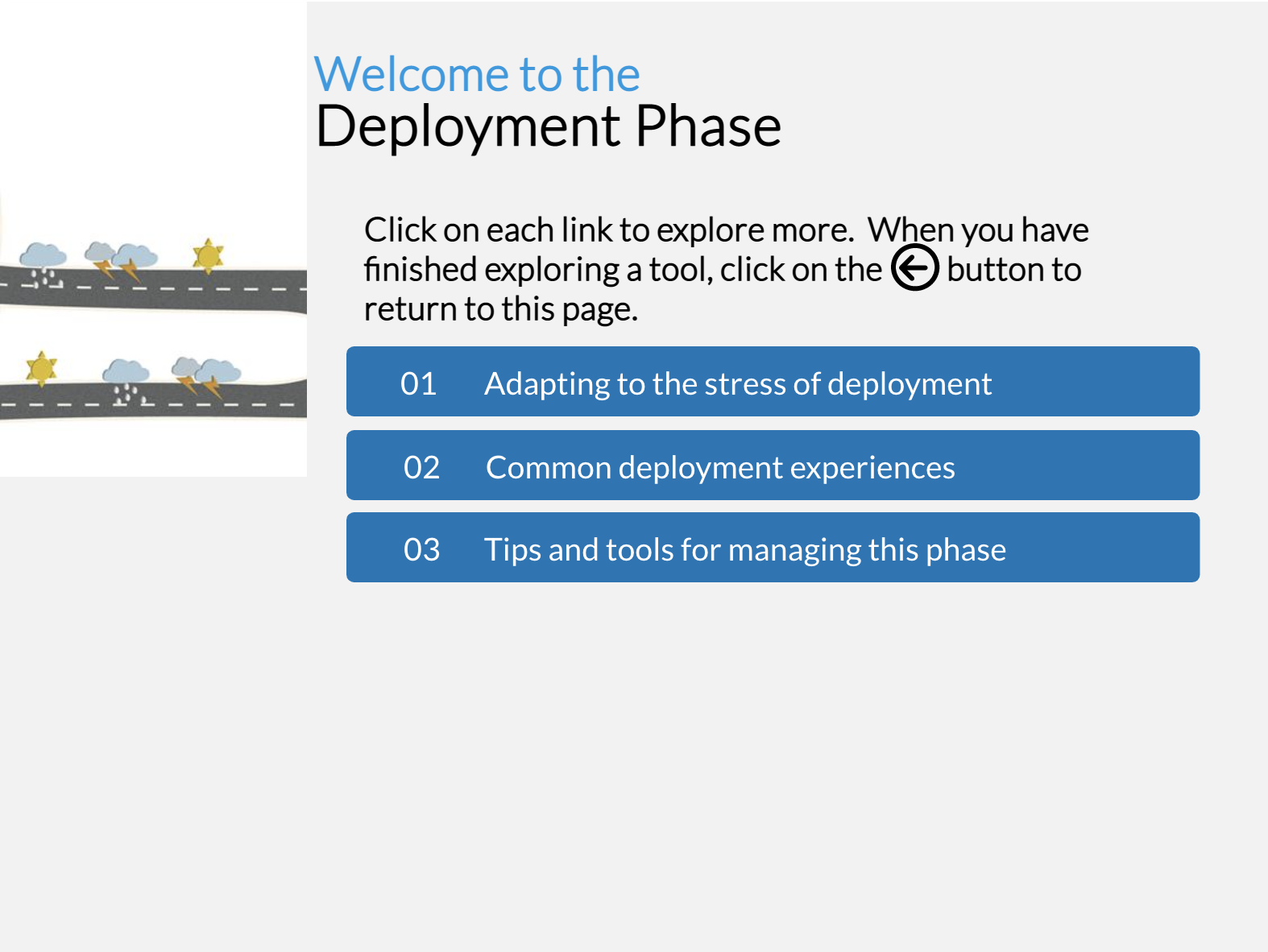
Estimated time: 10-15 min
Learning objectives
This section helps you reflect on some of your deployment concerns and provides some tips and tools to manage the challenges of this phase.
Rest stop (HLTA)
Rest stop (HLTA)
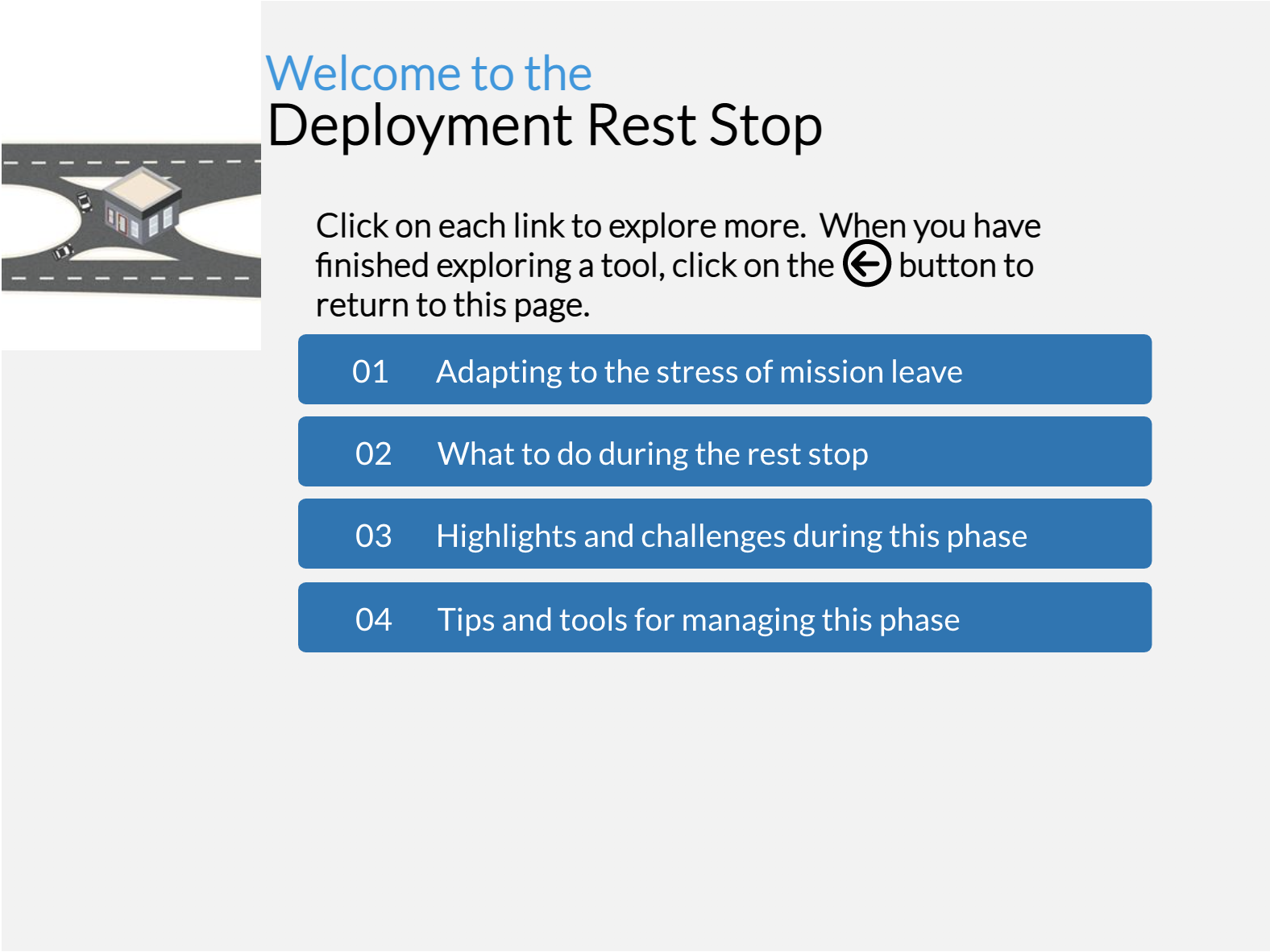
Estimated time: 10 min
Learning objectives
Here you have a chance to reflect on some of the highs and lows of mid-mission leave (often referred to as ‘HLTA’, which stands for ‘Home Leave Travel Assistance’), and strategies to plan for them.
Post deployment phase
Post deployment
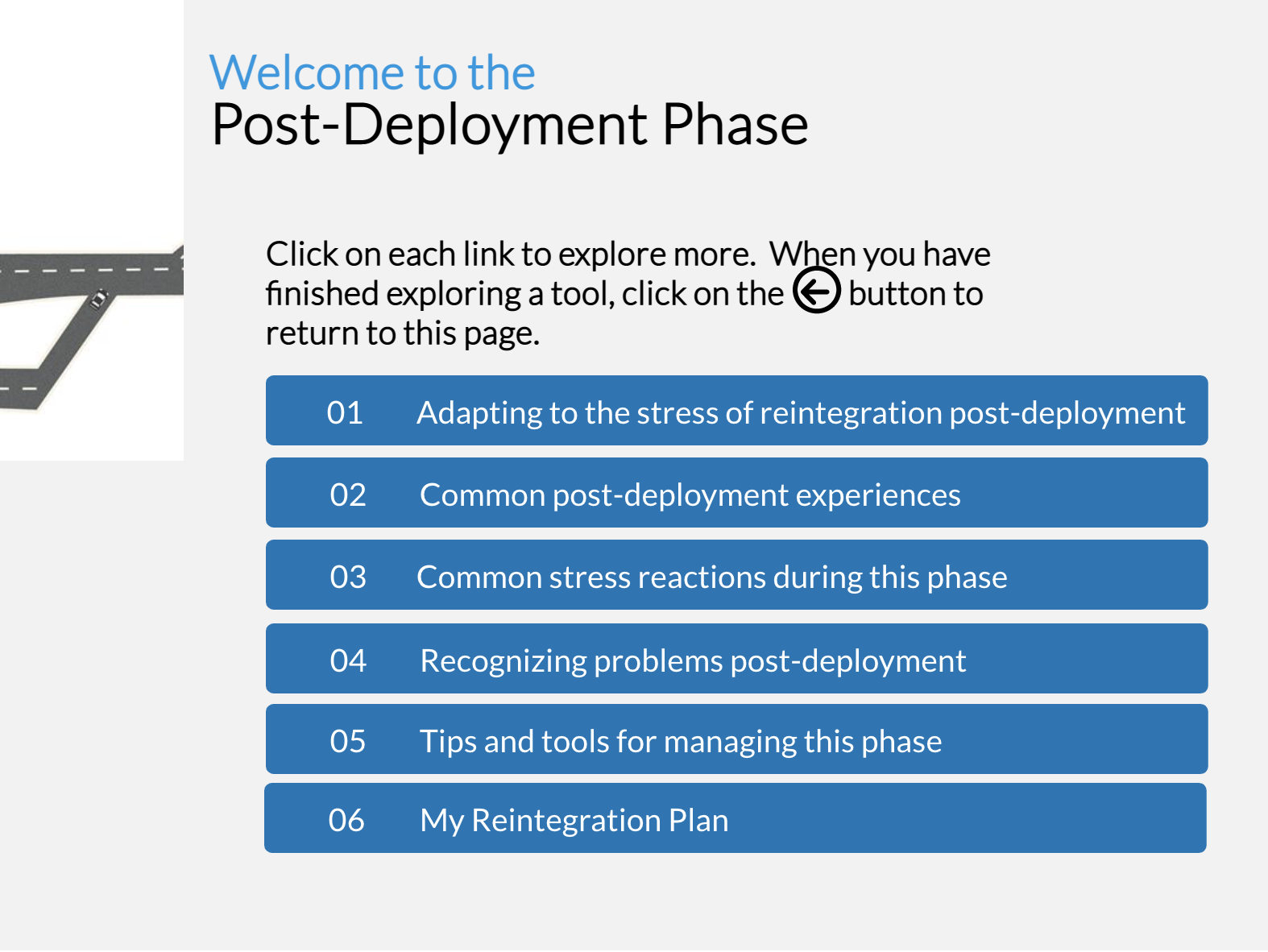
Estimated time: 15-25 min
Learning objectives
This section allows you to anticipate transition and reintegration, identify your concerns, and put strategies in place to manage some of the common experiences. You can also develop your own Reintegration Plan.
Parenting and deployment
Parenting & Deployment
Estimated time: 10 min
Learning objectives
The activities in this section provide an overview of common responses of children to the deployment of a parent, and ideas to support children through the deployment cycle.
Whether expected or unexpected, short or long, deployments are particularly tough for children. There are, however, opportunities for positive benefits. Military children often take on additional responsibilities in a parent’s absence, opening up the opportunity to develop new skills and hidden interests and abilities. In this changing environment, children tend to learn the importance of flexibility in dealing with everyday life. Deployments prepare children to manage changes which they will inevitably face in their lives. Not only do children learn how to say goodbye, but they also develop coping strategies and learn how relationships persist despite the absence of daily interaction. Since families need to make emotional adjustments during separation, they often discover and utilize new sources of strength.
This section aims to provide information to help CAF members and their families during the deployment cycle in their roles as parents.
Deploying with adult dependants
As parents grow older, adult children/caregivers are faced with changes and concerns that they may not know how to deal with. If your parents are elderly, ill or require full-time care, you may be feeling anxious about the deployment and wondering, “What if something happens while I am away?”
You may need to consider arrangements for someone to check on or care for your aging loved ones. For occasional care-giving assistance, consider supportive services such as home delivered meals, chore maintenance or visitor/companion services. The Deployment Support Group and Military Family Resource Centres may be able to provide guidance on what services may be available in a particular area. If not, the town or city, as well as local community organizations will be able to provide you with information on the services available in that community.
If your loved one needs direct care, contact home health care and/or employment agencies to inquire about professional in-home caregivers who may provide assistance. If your loved one is in a long-term care facility, inform the staff that you will be deploying and ask them to check on your loved one regularly. Keep your adult loved one informed of family and care giving changes and reassure him or her that the situation is temporary.
Your parents may have their own particular anxieties about your deployment, in particular your safety. Elderly parents have experienced war (either indirectly or directly), having lived through or served during armed conflicts. Like you would with your children and partner, talk openly with your parents about your deployment, concerns and anxieties. Include your parents in your welfare arrangements as appropriate (e.g. including them in unit activities, if in the local area, and providing them with ship, unit, Wing, Base, Deployment Support Group and Military Family Resource Centre contact information and details.) Provide them the contact information for Resources that are available to them.
Parents of deploying CAF members
Parents of deploying CAF members
Estimated time: 3-5 min
Learning objectives
This section provides information for parents of CAF personnel to help them prepare for their child’s deployment.
Deployment resources
Here are key resources available to support you and your family throughout the deployment cycle.
Family Information Line (FIL)
1-800-866-4546 (International 00-800-771-17722)
FIL-LIF@cfmws.com
The Family Information (FIL) is a confidential, bilingual and free service offering information, emotional support, referrals, reassurance and crisis management to the military community. The FIL is staffed by a team of trained counsellors. The line is open for calls 365 days a year, 24 hours a day.
Military Family Resource Centres (MFRC)
MFRCs are responsible for connecting military families to a wide range of programs and services. If you are facing a deployment and would like further information about what to expect or how to navigate the deployment cycle, contact your local MFRC for guidance and support.
Canadian Forces Member Assistance Program (CFMAP)
1-800-268-7708 (TDD 1-800-567-5803)
Calling from outside Canada: Dial the International Access code of the country from which you are calling and then 800-268-7708
The CFMAP offers confidential, voluntary, short term counselling to assist military members and their families with resolving many of today’s stresses at home and in the workplace. The CFMAP phone line is toll free and staffed 24 hours a day, 365 days a year by a fully bilingual, trained counsellor. The role of the telephone counsellor is to refer the client to a counsellor in private practice for face-to-face counselling, and if the client is in crisis, to provide counselling over the phone. For further details regarding eligibility and service provision, please refer to the CFMAP website.
To know more about what other mental health resources are available for you and your family, refer to the Resources section of the R2MR Family website for further details.
CFMWS Deployment Support
We know that deployments and work-related absences can be challenging, not only for the person deploying, but for those who are left behind. We are here to help you through all phases of your work-related absence by providing information, resources and linking you to your local MFRC / MFS service provider.